(and Why It Reveals Everything Wrong with the Current “Anti-Curassavica Crusade” in Florida)
In early December 2025 I received an email that has unfortunately become all too common. A well-meaning gardener in Florida wrote to inform me that “tropical milkweed seeds” (Asclepias curassavica) had somehow contaminated the native milkweed seeds she bought from Johnny Butterflyseed. She was “very on top of [her] yard,” a professional landscaper no less, and was certain the offending seedlings appeared exactly where she had planted our seeds. She promised to “happily pull them up” but wanted to warn me in case other customers noticed the same thing.
What followed was a textbook example of almost every logical, scientific, and horticultural error that has turned a useful, beautiful Florida milkweed into public enemy #1 for monarch butterflies. I’m publishing the exchange (anonymized only slightly) because it is the perfect teaching moment for everyone who sells, grows, or simply cares about milkweed in the Southeast.
The Actual Exchange (lightly edited for clarity)
Customer (Dec 4): “I ended up with a bunch of tropical milkweed seeds in my native seeds… The tropicals came up exactly where I planted some of the natives that I got from you guys… I’m happy to pull them up…”
My first reply (Dec 9): “Identifying Asclepias seedlings early is extremely challenging… Tropical milkweed is not a weed and is native to South Florida… Frost will likely reduce its growth in your area, so please avoid removing healthy plants unnecessarily.”
Customer’s immediate second email (one minute later): “Yes, tropical milkweed is considered invasive in Florida… It is harmful to monarch butterflies because it can disrupt their migration patterns… Please don’t encourage people to plant or keep tropical milkweed.”
My final reply: “I’m not looking to debate… My intention is simply to point out that discarding milkweed seedlings you can’t reliably identify may inadvertently reduce the plants available to monarchs.”
Customer (one minute later): “I’m sorry you are not open to healthy debate. I’m very discouraged by this conversation!”
She never addressed the identification problem, the lack of evidence, or the native status in South Florida. She simply repeated the slogans she had memorized and refused to listen.
She burned down her own kitchen to kill a single cockroach, then blamed the grocery store for selling matches.
She’s the vegan who orders a $200 box of rare heirloom beans from an organic farm, dumps the whole thing straight into her backyard compost pile, waits three weeks, then starts ripping out every green sprout screaming “THIS IS ROUNDUP-READY GMO SOY!!” She then mails the farmer a furious letter accusing him of contaminating the entire harvest with Monsanto seeds, posts grainy photos of bean sprouts to a Facebook group titled “Exposing Toxic Bean Dealersellers,” and triumphantly declares she’s saving the planet by ensuring no beans ever grow on her property again, while the farmer just stares at the meticulously labeled packets he ships and wonders why he bothers.
Self-Sabotage Loop
She’s the living embodiment of the self-sabotage loop that’s been playing out across the entire monarch conservation space for a decade:
- Spend money and effort to acquire rare native milkweed seed.
- Plant it carelessly, without controls or records.
- See a seedling that triggers the “tropical = evil” alarm that was installed by a 2014 Xerces Society fact sheet.
- Rip out the milkweed seedling with righteous fury.
- Blame the seed vendor.
- Repeat until there is literally no milkweed left in the county.
The irony is almost performance art: the same person who is most afraid of “losing the migration” is personally ensuring that the next generation of monarchs has zero host plants in her yard because she destroyed them all before they could bloom and be correctly identified.
The Timeline of Errors
- No germination protocol was followed The customer never started the seeds in labeled trays with dates. She direct-sowed an unknown quantity of unknown species of native milkweed seed into her yard and then declared that any seedling that looked “wrong” must have come from us. This is the equivalent of baking a cake with five different bags of flour and then blaming one supplier because the cake tastes funny. Proper milkweed germination protocol exists for exactly this reason: so you can track what actually germinates.
- Seedlings were identified at the cotyledon/early true-leaf stage Milkweed seedlings are notoriously difficult to tell apart when they are tiny. Swamp milkweed (A. incarnata), common (A. syriaca), whorled (A. verticillata), and yes, even some tropical milkweed all produce nearly identical cotyledons and first true leaves. Positive identification usually requires flowers or at minimum mature foliage. Pulling seedlings at this stage is botanical Russian roulette.
- Zero photographic or descriptive evidence was provided. No pictures, no leaf measurements, no location coordinates, nothing. Just a confident declaration.
- The plant in question is not legally invasive in Florida As of December 2025, Asclepias curassavica is NOT listed on the Florida Invasive Species Council’s list as a Category I or prohibited plant. In June 2025 the Florida Exotic Pest Plant Council did move it to Category II (species that have increased in abundance but have not yet altered plant communities to the extent of Category I species). Category II is not the same as “invasive” in the regulatory sense, and it certainly does not trigger removal mandates on private property. More importantly, A. curassavica is native to South Florida. It has been documented in natural areas from Miami-Dade to Martin County since at least the 1800s. Telling all of Florida “do not plant this” because California researchers dislike it in their climate is a massive mistake that hurts the Monarch population by still starving it of Milkweed in the name of citizen science.
- The “it disrupts migration” claim is misused and oversimplified. The famous Griffin/Altizer OE-migration papers were conducted in California, Oklahoma, and a few northern locations where A. curassavica is a non-native perennial that blooms year-round because it never freezes. In peninsular Florida, frost or cold weather knocks tropical milkweed back exactly like it does with native perennials. Monarchs already overwinter in Florida; they have for millennia. The plant does not turn the entire state into a migration trap the way it can in frost-free coastal California.
- Tropical Milkweed casts its seed in Central Florida during early December by sending them airborne on coma.
- The customer’s ultimate mission conflict: She is compulsively removing perfectly good milkweed, some of which is almost certainly the rare native species she paid for, because an internet consensus told her that one particular milkweed is “bad.” The monarch caterpillars do not care about our human categorical obsessions. They only care that there is latex on the menu.
The Bigger Pattern
This is not about one customer. This is about an entire movement that has replaced observable ecology with slogans and false binaries:
- There is only Native or Non-Native (ignorant of Naturalized, Endemic, Cosmopolitan, Indigenous, Archaeophyte, Neophyte, etc.)
- Only California and its Social Media knows the “good” milkweed for Florida
- Native “Good” / Non-Native “Bad”
- Non-Native = Invasive (False Equivalence)
- Tropical Milkweed = Evil (False Equivalence)
- Pull First, Identify Later
- If You Disagree You Are Harming Monarchs
Real Florida ecologists (people who actually work here, not just model data from 2,000 miles away) understand that plant distribution is a continuum. Asclepias curassavica is native in the southern part of the Florida peninsula, because it is part of the Neotropical Realm. Tropical Milkweed is Naturalized but not ecosystem-altering in Central Florida, and a non-native perennial that can persist in the northern counties and the Panhandle, but is usually eradicated by frost. One size does NOT fit all 67 counties.
What You—Our Customers—Should Actually Do
- Germinate in labeled trays with dates.
- Wait until plants are large enough to identify confidently (usually flowering).
- In frost-free South Florida, feel free to grow A. curassavica; it’s native there.
- In North Florida, cut it back in late fall if you observe OE spores in your microscope.
- Never, ever rip out milkweed seedlings because someone on Social Media told you they “look tropical.”
Monarch caterpillars are facing habitat loss, pesticides, and climate change. They are not facing a crisis caused by the existence of a pretty orange and red milkweed that has been in Florida longer than Miami has been a city.
Let’s stop fighting each other and “Plant More Milkweed!!” .. which is accurately identified, regionally appropriate, and in abundance… one day at a time!
Johnny Butterflyseed
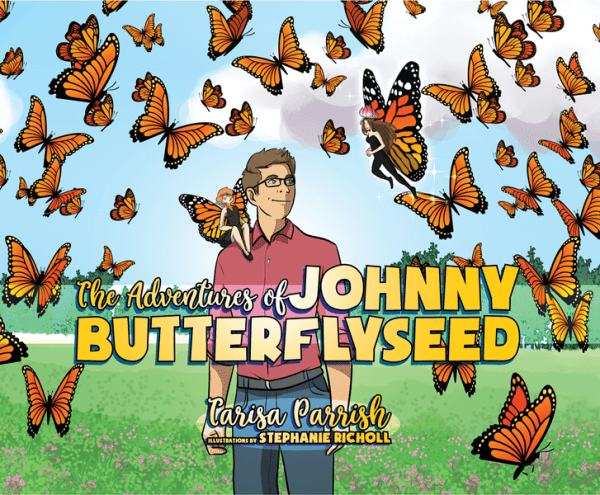
The Adventures of Johnny Butterflyseed – Author Signed First Edition Children’s Book
Save the monarchs!
Johnny Butterflyseed and his fairy friend, Raven Silverwing, embark on a mission to save the rapidly disappearing butterflies. They enlist the help of Queen Venus Goldwing and her kingdom of monarchs to educate and inspire kids to become butterfly farmers. At first, Johnny faces his own internal struggle with self-doubt and fear in his ability to make a difference, but then soon develops a mindset that allows him to not only get started, but also make progress one day at a time. Through challenge after challenge, Johnny learns that he is not alone in his mission and that there are many people who want to help. Together, Johnny, Raven, and Queen Venus educate thousands of children on becoming butterfly farmers.
307 in stock